Summary
- The supply of new issues will likely fall as rates rise, creating an imbalance between supply and demand.
- Historically municipal bonds have avoided losses in a rising interest rate environment.
- Municipal bonds currently are trading at attractive historical levels relative to taxable bonds.
The bond market (NYSEARCA:BND) is bracing for a smackdown when the Federal Reserve hikes interest rates. The CME Group’s FedWatch Tool shows the Fed-funds futures market is pricing in a 52% chance of a 50 basis point increase at the Fed’s Dec. 16 meeting. That’s a sharp rise from a 34% reading last week before the Fed’s policy statement. The probability gauge rises to 61% for the January meeting next year and 75% for March 2016. Intermediate and long duration bonds of all stripes will lose principal when rates rise. Municipal bonds (NYSEARCA:MUB), however, are relatively safe from a rate hike. The stars seem to be aligning in their favor. Here are five reasons why.
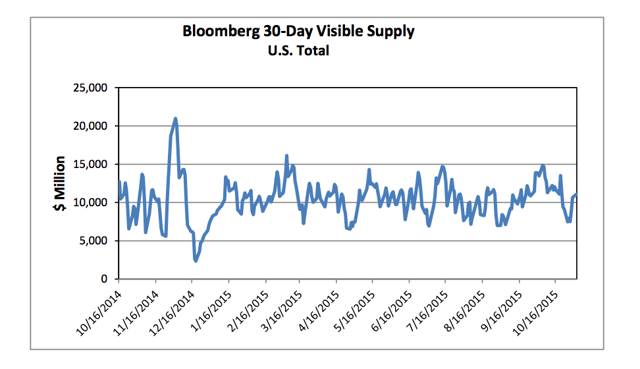
1. The supply of new issues will likely fall as rates rise, creating an imbalance between supply and demand. New issue volume has been falling since June. September new issue volume was the lowest in one and half years, according to Janney Montgomery Scott’s monthly municipal bond report from October. Municipalities will likely issue less debt in a rising rate environment.
Refundings fell 38.3% in October 2015 from the year-ago period, according to RW Baird, citing Bond Buyer data. Total issuance declined from October 2014. Sept. 2015 issuance also dropped year over year.
(Robert W. Baird Municipal Bond Market Weekly, Nov. 2, 2015)
“Because so much issuance this year has been refunding of older debt due to current low rates there could be a reduction in new issuance making munis more valuable as a result of better supply/demand technicals,” says John Donovan, senior vice president of municipal trading at Drexel Hamilton in New York City. “And somewhat counterintuitively, the start of tightening could lead to lower equities and add to the demand for munis in a rotation type trade.”
Matthew Carbray, CFP®, ChFc®, a certified financial planner and partner at Carbray Staunton Financial Partners LLC in Avon, Conn., says: “With reduced new supply coming to market and the likelihood that there will be less refinancing activity on existing muni debt due to higher rates, the fundamentals for municipal bond investing look strong.”
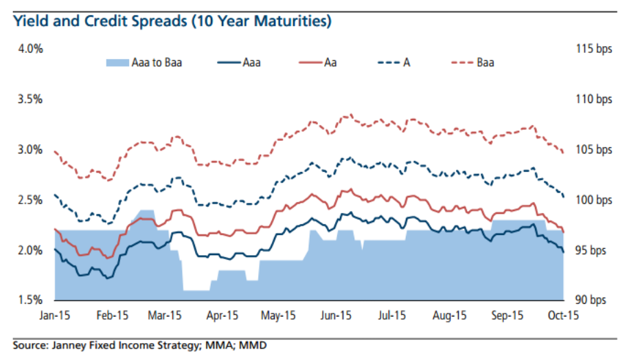
Carbray recommends buying high-yield munis (NYSEARCA:HYMB) because spreads have widened enough to justify the credit risk in many cases.
(Janney Montgomery Scott, “Municipal Bond Market Monthly,” Oct. 6, 2015)
2. Historically municipal bonds have avoided losses in a rising interest rate environment. It’s doubtful that longer-term rates will rise dramatically when the Fed lifts the policy rate. The yield curve will likely flatten. Long-term rates (NYSEARCA:BLV) are more sensitive to expectations of inflation, which is basically non-existent thanks to falling commodity prices. Energy prices are expected to remain low for the foreseeable future because of the fracking boom.
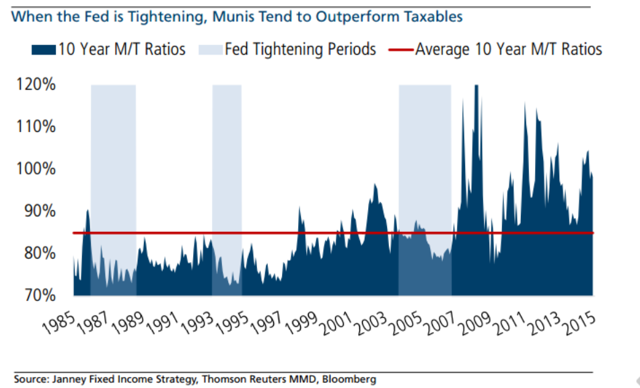
A primary indicator of municipal relative value is the ratio of 10-year AAA yields to like maturity Treasury yields (NYSEARCA:IEF). Janney Montgomery Scott’s graph below shows during rising interest-rate periods in the late 1980s, the mid-1990s and the mid 2000s, muni ratios fell. That means muni yields fell (as prices rose) relative to Treasuries.
“With ratios currently hovering around 100%, despite high marginal income tax rates, we see more downside bias to M/T ratios than upside likelihood,” Alan Schankel, managing director at Janney, wrote in a client note issued Sept. 17.
(Janney Montgomery Scott, “Munis in a Tightening Cycle,” Sept. 17, 2015)
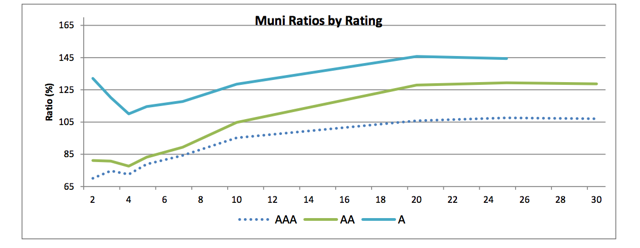
3. Municipal bonds currently are trading at attractive historical levels relative to taxable bonds. The lower the credit rating and the longer the duration, the higher the muni valuation relative to equivalent Treasuries as this chart from RW Baird shows.
Muni Index Ratios by Maturity and by Credit Rating
(Data Source: Bloomberg; Baird Municipal Bond Market Weekly Nov. 2, 2015)
“This has a very important implication for investors, as it means that despite the fact that municipal bonds’ income is tax-free – consequently, their rates should be lower. But their yields on maturities greater than 20 years are higher than those on treasury bonds,” Keith Lanton, president of Lantern Investments with $1 billion in client assets in Melville, N.Y. “Of course, the latter are backed by the full faith and credit of the United States. Nevertheless, municipal bonds levels over 100% are high by historical standards.”
4. Arguably, muni bond prices have already priced in an interest rate hike because it has been anticipated for so long. Jefferies’ team of economists and analysts used a handful of complicated models to conclude there will be a December liftoff. They project a 2% Fed funds rate at year-end 2015. They forecast the Fed funds to reach at least 3% by year-end 2016 and 3.75% or higher in late 2017.
“The rate normalization process, of course, will depend upon the economy and inflation continuing down the path toward more normal economic and inflation conditions,” Ward McCarthy, managing director and chief financial economist at Jefferies and his colleagues wrote in a client note Oct. 30. “Consequently, the projected fed funds rate in all of these models is based on the same projections for a continued decline in the unemployment rate to as low as 4.5% and a gradual rise in inflation back toward the Fed’s 2% target.”
Jefferies’ model does not factor in overseas uncertainty. Crude oil prices and import prices are huge wild cards that could affect the inflation rate.
5. Knee-jerk market reactions present a chance to take advantage of volatility. When bonds sell off, yields rise. Therefore, educated investors can swoop up higher-yielding bonds to increase income. Over the past two decades, muni yields have typically fallen from their highs. Over the long term, yields are the primary contributor to total returns than price appreciation for muni bond investors. Over the short term, income helps cushion price declines. Unless credit quality deteriorates, bond prices usually stabilize relatively quickly as the yield rises.
Franklin Templeton’s chart below shows that although prices of municipal bonds dropped in 12 out of the 24 calendar years between 1990 and 2014, the bonds’ yield income helped offset losses in price. After factoring in income, municipal bonds only saw negative total returns in four out of the 24 years.
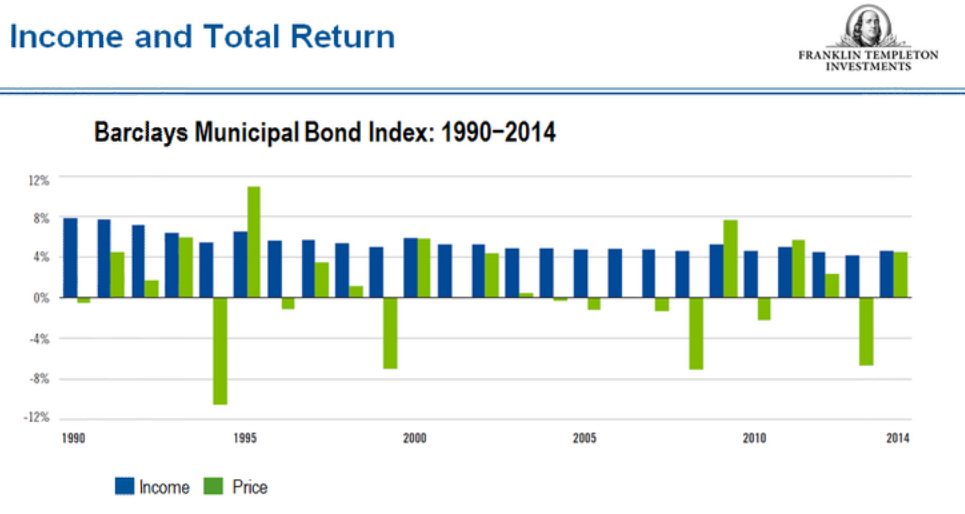
(Franklin Templeton, “In the Know: Seven Myths About Municipal Bonds,” May 7, 2015)
Seeking Alpha
Robert Kane, BondView
Research analyst, municipal bonds, event-driven, macro
Nov. 5, 2015 4:48 PM ET